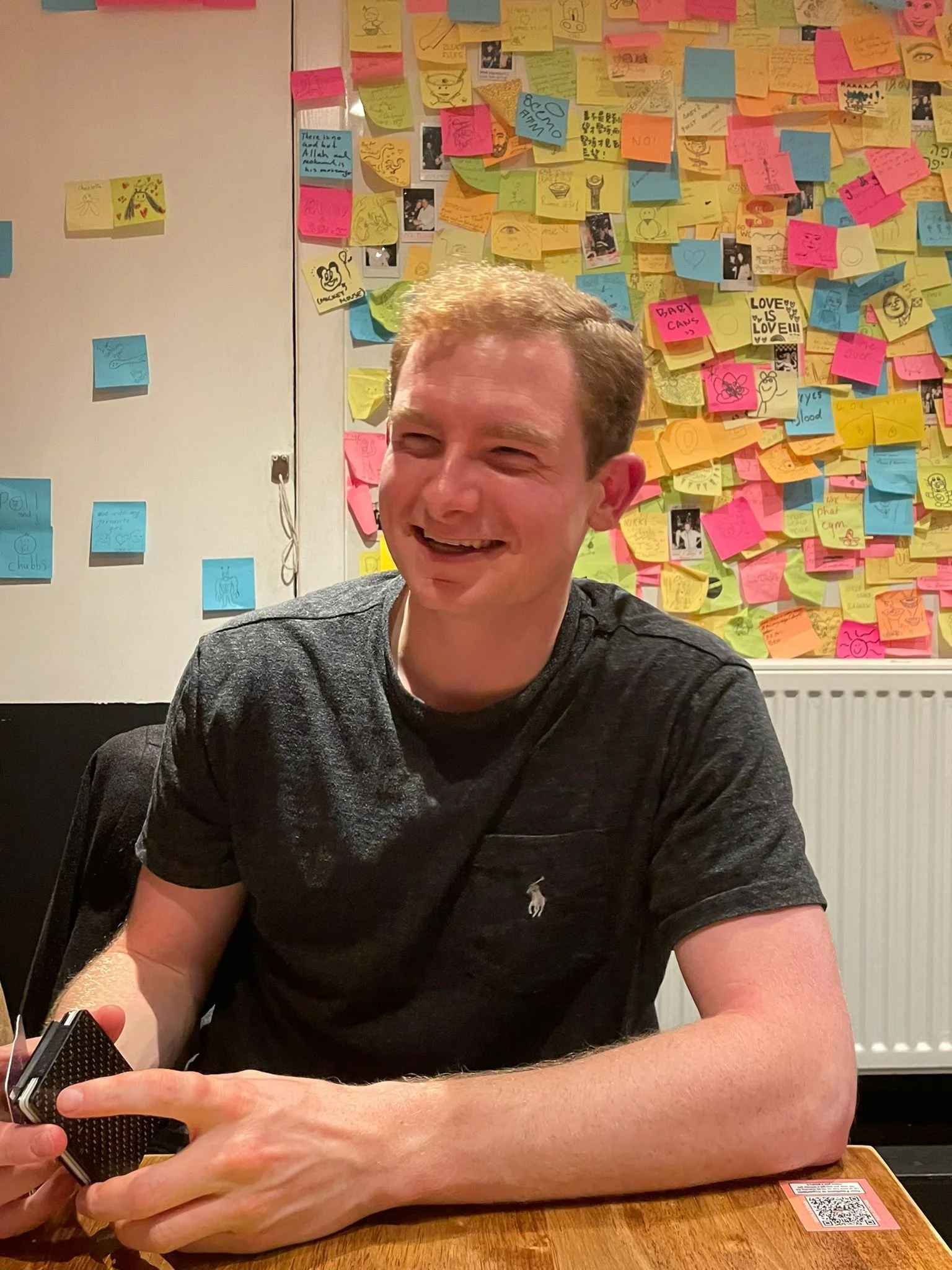
Jason Segall
I'm Jason Segall, a writer, editor, and science communicator fascinated by how we make sense of the world. With Master's degrees in Theoretical Physics and Science Communication, I spend my time researching complex topics and turning them into stories that people actually want to read, watch, and share. My work to date spans physics, mathematics, biotechnology, and data science, with bylines and scripts for organisations including Quantics Biostatistics and PBS Space Time. Whether I'm writing about the end of the universe, the mathematics of symmetry, or the statistics behind clinical trials, my goal is always the same: to make difficult ideas understandable, engaging, and memorable.
Quantics Biostatistics
Longform blogs covering a wide range of topics across the biosciences, including bioassay, clinical trials, and vaccine development. Incorporating expert statistical insight from the team at Quantics, blog readership increased by 300% thanks to high-quality content produced with reader interest, industry trends, and SEO-optimisation in mind.
Highlights
Bayesian Sample Size Calculations for Clinical Trials
A deep dive into Bayesian approaches to clinical trial design, examining how prior knowledge and probability modelling can be used to determine sample sizes more efficiently than traditional methods. The article breaks down complex statistical concepts for a non-specialist audience while highlighting their practical applications in pharmaceutical research and drug development.
Design of Experiments for Bioassay Optimisation
A case study examining the use of Design of Experiments (DoE) to optimise a cell-based bioassay in collaboration with RoukenBio. The article follows the development process from identifying critical assay factors to implementing a statistically designed experiment, illustrating how modern experimental design techniques can accelerate assay development while generating deeper scientific insight than traditional methods.
Natural History Studies for Vaccine Development
This article examines the often-overlooked natural history study, a crucial early stage in vaccine development that helps researchers understand how a disease behaves before intervention. By exploring study design, disease progression, immune responses, and ethical considerations, the piece shows how foundational scientific research shapes every subsequent stage of vaccine testing and development.
Medium
This collection of essays explores the ideas, discoveries, and people that have shaped modern physics and mathematics. Covering topics ranging from vacuum decay and symmetry in nature to the history of astronomy and scientific discovery, the articles aim to uncover the stories behind some of science's most profound concepts. Written for a general audience, they combine rigorous research with accessible storytelling to make complex ideas both understandable and engaging.
Highlights
Vacuum Decay: The End of the World May Have Already Happened
This article explores the physics of vacuum decay, a theoretical process that could fundamentally alter the laws of nature across the universe. Beginning with conditions in the moments after the Big Bang, it explains concepts such as symmetry breaking, quantum fields, and false vacuum states before examining the unsettling possibility that our universe may exist in a metastable state. Combining particle physics, cosmology, and quantum mechanics, the piece translates a highly technical topic into an accessible narrative about one of the most dramatic end-of-the-universe scenarios ever proposed.
Noether’s Theorem: How Symmetry Shapes Physics
The Physics of the Graphene Revolution
This article explores Emmy Noether's revolutionary theorem linking symmetries in nature to the fundamental conservation laws of physics. Beginning with the historical context of Noether's work and her contribution to general relativity, it explains how seemingly abstract concepts such as symmetry give rise to the conservation of energy, momentum, and angular momentum. The piece combines biography, mathematics, and physics to show why Noether's theorem is often regarded as one of the most profound and far-reaching ideas in modern science.
Graphene has been hailed as a wonder material capable of transforming everything from electronics and energy storage to aerospace engineering. This article explores the physics behind graphene's remarkable properties, examining how a single layer of carbon atoms can be simultaneously stronger than steel, highly conductive, and almost completely transparent. Along the way, it explains the quantum mechanics, atomic structure, and scientific breakthroughs that underpin one of the most significant materials discoveries of the modern era, separating genuine technological promise from the hype surrounding the so-called "graphene revolution."
PBS Space Time
As a freelance scriptwriter for PBS Space Time, I researched and wrote episodes on topics including cosmic strings and constructor theory. The role involved translating cutting-edge theoretical physics into engaging, accessible narratives for a global YouTube audience, combining deep technical research with audience-focused storytelling.
This video explores the idea of cosmic strings: hypothetical defects in the fabric of the universe that may have formed during symmetry-breaking phase transitions shortly after the Big Bang. Using analogies drawn from cracks forming in ice, the video explains how these one-dimensional concentrations of energy could stretch across the cosmos while remaining thinner than a proton. It examines the physics of topological defects, how cosmic strings might interact with matter and spacetime, and the observational signatures scientists are searching for today, including gravitational waves and gravitational lensing. The episode combines cosmology, particle physics, and general relativity to investigate one of the most intriguing potential relics of the early universe.
This video episode explores constructor theory, a radical proposal by physicists David Deutsch and Chiara Marletto that seeks to reformulate physics in terms of what transformations are possible and impossible, rather than describing how systems evolve through time. The episode examines how this shift in perspective could provide a deeper framework for understanding information, computation, thermodynamics, and even the search for a unified theory of physics. Through a series of thought experiments and examples, it introduces the idea of a "science of can and can't" and investigates whether constructor theory could reveal hidden connections between some of the most fundamental laws of nature.
About
MPhys Theoretical Physics
University of St Andrews, 2016-2021
Completed an Integrated Master ’s degree in Theoretical Physics, with studies encompassing additional topics in Organic Chemistry, History of Mathematics, Astrobiology, and Computer Science.
MSc Science Communication and Public Engagement
University of Edinburgh, 2021-2022
Developed expertise in translating complex scientific concepts for diverse audiences. Relevant modules included: Science Education, The Role of Social Media in Science Communication, and a year-long work placement.